Tribal, state, federal and local courts operate in a patchwork of overlapping jurisdictions, facing common challenges and limited resources. To address these concerns, a growing number of courts have come together in a joint jurisdictional model that acknowledges each other’s autonomy, while sharing resources for better outcomes for everyone.
Joint Jurisdictional Courts Defined
Jurisdiction is exercised jointly when a tribal court judge and a state or federal court judge exercise their respective authority simultaneously, bringing together justice system partners to promote healing and protect public safety. Joint exercise of jurisdiction allows the systems to leverage resources, reduce administrative costs, effectively deliver services that are culturally based, and achieve better results for individuals involved in the civil and criminal justice systems. In a joint jurisdictional court, a state/federal court judge and a tribal court judge preside together over a docket that provides tribal (and nontribal) individuals, and in some cases their families, with a court-supervised alternative that is trauma informed and emphasizes community values and culture.
Using innovative joint jurisdictional agreements, tribal, state, and federal jurisdictions bring together their strengths, reflect the unique circumstances of different tribal nations, and successfully address the challenges they face.
Never before has intergovernmental collaboration been so crucial. In the aftermath of Oklahoma v. Castro Huerta, Joint jurisdiction courts have the potential to alleviate jurisdictional uncertainties that will undoubtedly emerge in instances when tribal, federal and state jurisdiction overlap.
Joint Jurisdictional Court Resources
Promising Strategies: Tribal-State Intergovernmental Collaborations
Jenny Walter, Hon. Korey Wahwassuck, Tribal Law and Policy Institute (February 2024)
On July 26, 2021, the Tribal Law and Policy Institute, in collaboration with the Bureau of Justice Assistance, held the “Promising Strategies in Tribal-State-Local-Federal Intergovernmental Collaboration Virtual Meeting.” The panelists highlighted intergovernmental collaborations in child welfare, bail reform, family wellness courts and community wellness courts from Alaska, California, New York, and Maine. The meeting was well attended by invited stakeholders from various disciplines, including Tribal and State courts and law enforcement. TLPI drafted a short publication based on these and other promising intergovernmental collaborations that build resiliency and provide a new way forward in the process. This publication showcases six intergovernmental collaborations with resulting variations in reimagining justice.
Intergovernmental Collaborations to Heal, Protect, and Find Solutions: Joint Jurisdiction 101
Hon. Korey Wahwassuck, Hon. Abby Abinanti, Tribal Law and Policy Institute (October 2023)
This publication provides general guidance to assist Tribes in making an informed decision concerning the possibility of developing a Joint Jurisdiction Court. The publication discusses what a Joint Jurisdictional Court is, the different models and approaches that exists, how a community can assess their readiness to implement a Joint Jurisdictional model, and will provide recommendations for design, development, and implementation of Joint Jurisdictional Courts from a practical standpoint. The publication also includes resources and tools used by active joint jurisdictional court practitioners.
Joint Jurisdiction Courts: Needs Assessment Findings and Summary Findings
Jenny Walter, Hon. Korey Wahwassuck, Suzanne M. Garcia, Tribal Law and Policy Institute (February 2022)
In September 2019, the Tribal Law and Policy Institute, in collaboration with the Bureau of Justice Assistance, disseminated a needs assessment survey to the joint jurisdiction courts known to be operational. The needs assessment survey responses showed that joint jurisdiction courts share similar characteristics and face similar challenges. The full report provides details on the findings of the needs assessment survey, including an overview of the lessons learned, the effectiveness of joint jurisdiction courts, and the funding needed to support their implementation, sustainability, and growth. The shorter report summarizes key take-aways.
Tribal-State Court Forums: An Annotated Directory
Heather Valdez Freedman, Catherine Retana, Kori Cordero, Carrie Garrow, and Jenny Walter, Tribal Law and Policy Institute (2020)
This directory includes a detailed listing of the 13 currently operational Tribal -State Court forums around the nation. These forums provide unique collaboration opportunities across jurisdictions and have led to such positive outcomes as: agreements on the transfer of jurisdiction, Indian Child Welfare Act education, tribal court directories, legislation on the enforcement of tribal court orders, judicial relationship building, and many more. Information on each forum includes: membership; funding; structure; organization; key accomplishments and authorizing documentation.
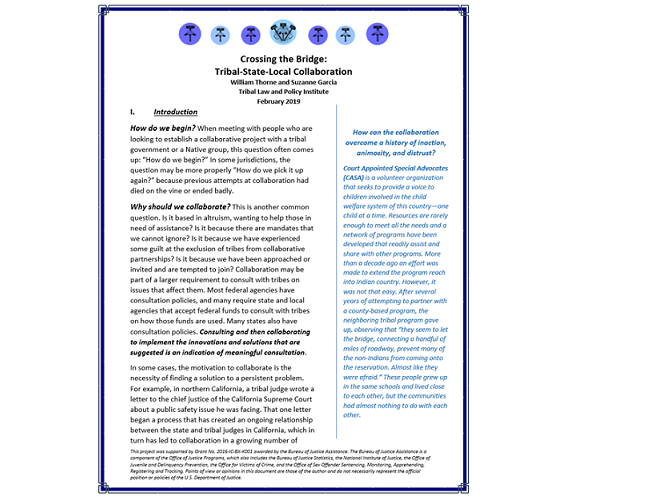
Crossing the Bridge: Tribal-State-Local Collaboration
William Thorne and Suzanne Garcia, Tribal Law and Policy Institute (February 2019)
One of the biggest barriers to successful tribal-state collaboration is taking the first steps toward relationship building. The historical animosities between tribes and local counties/surrounding states can run deep. Strained relations going back many generations and contentious issues such as land, public safety, etc. can make for what may seem like insurmountable problems. This can leave those who see collaboration as a possible solution with little hope. This publication gives practical steps toward initiating discussions across jurisdictions. This publication provides details on “crossing the bridge” to meet jurisdictional peers and begin the relationship building necessary for collaborative endeavors that work toward common goals.
Emerging Strategies in Tribal-State Collaboration: Barriers and Solutions to Enforcing Tribal Protection Orders Meeting Report
Jennifer Walter and Heather Valdez Freedman, Tribal Law and Policy Institute (February 2019)
Tribally issued protection orders are a crucial means of providing safety and justice in Indian country, particularly given the extremely high rates of violence against Native women. However, for protection orders to be an effective means of providing safety, cross-jurisdictional enforcement is necessary, which can be a challenge. On December 6, 2017, the Tribal Law and Policy Institute, in collaboration with BJA, hosted a day-long meeting to explore the barriers and highlight promising strategies around the enforcement of tribal protection orders. This report details those discussions and summarizes the successful efforts.
Promising Strategies: Tribal State Court Relations
Carole Goldberg and Duane Champagne, Tribal Law and Policy Institute (March 2013)
Tribal courts and state courts interact across an array of issues, including child welfare, cross jurisdictional enforcement of domestic violence orders of protection, and civil commitments. Since the early 1990s, initiatives by judges’ organizations within both judicial systems have focused on an agenda of greater mutual understanding and cooperative action. This publication spotlights some of the most successful strategies within these initiatives. Click here to read full document.
Promising Strategies: Public Law 280
Carole Goldberg and Duane Champagne, Tribal Law and Policy Institute (March 2013)
In PL 280 jurisdictions, the concurrent jurisdiction of state and tribal courts over criminal prosecutions and civil actions arising in Indian Country creates many interactions and complications. Tribal and state authorities encounter one another across an array of issues, including government-to-government recognition, concurrent jurisdiction, cross-jurisdictional enforcement of domestic violence orders of protection, cross-deputization, and civil commitments. Tensions and misunderstandings have been common features of tribal and state policing relations in the past, sometimes erupting in jurisdictional conflicts. This publication highlights unique ways in which tribal and state jurisdictions have entered into collaborations to overcome barriers to effective justice provision. Click here to read full document.
Joint Jurisdiction Courts: A Manual for Developing Tribal, Local, State & Federal Justice Collaborations
Jennifer Fahey, JD, MPH, Hon. Korey Wahwassuck, Alison Leof, PhD, Hon. John Smith, Project T.E.A.M., Center for Evidence-Based Policy, Oregon Health & Science University (June 2018).
Hon. Korey Wahwassuck, Alison Leof, PhD, Hon. John Smith, Project T.E.A.M., Center for Evidence-Based Policy, Oregon Health & Science University. This manual is a roadmap for tribal and community leaders who want to develop joint jurisdiction courts or initiatives in their own communities. It is intended to be a guide, articulating the process developed in one Minnesota community and adopted by other jurisdictions, as well as providing information on creating new joint jurisdiction initiatives. This manual includes references to supplementary materials which may assist tribes and their partners in establishing and managing joint jurisdiction courts.
Tribal and State Courts: Strategies for Bridging the Divide
Aaron Arnold, Sarah Reckess, and Robert Wolf, Center for Court Innovation (2011)
This report notes that while State and Tribal courts in many areas of the country have overlapping jurisdictions and need to deal with local problems that impact both systems, past cultural differences and inconsistent Federal policies have contributed to ongoing tensions between State and Tribal governments that have prevented these entities from working effectively for their communities. This report from the Center for Court Innovation details current collaboration efforts to bridge these differences. The report begins with a discussion on the historical background of the problem and presents information on Federal Indian policy and the development of Tribal courts. This is followed by a discussion of current barriers to communication that includes jurisdictional confusion, misperceptions, and the impact of Federal policies. Current collaboration efforts to bridge the differences between State and Tribal courts are also discussed and include State-Tribal court forums, joint jurisdiction courts, written agreements, culturally-competent programs in State courts, and professional training. Some of the culturally-competent programs discussed in the report include sentencing circles, elder mentoring, and adoption/subsidized guardianship.
Building a Legacy of Hope: Perspectives on Joint Tribal-State Jurisdiction
Hon. Korey Wahwassuck, Hon. John P. Smith, and Hon. John R. Hawkinson, 36:2 William Mitchell L. Rev. 859 (2010)
This article explores how joint jurisdiction courts developed, gives a brief overview of the nature of tribal-state-federal relationships, outlines the historical and legal basis for tribal-state collaborative agreements, and demonstrates how this innovative approach to justice allows for more effective administration of justice and far better results across all systems.
The New Face of Justice: Joint Tribal-State Jurisdiction
Hon. Korey Wahwassuck, 47 Washburn L. J. 733 (2008)
This article gives an overview of tribal court development, discusses how this unique system of joint jurisdiction evolved in Northern Minnesota, and provides practical suggestions for cooperation in other jurisdictions. The article includes extensive history of state and tribal court relations and the reasoning behind the agreement between the Leech Lake Tribal Court and Cass County Court.
From Conflict to Cooperation: State and Tribal Court Relations in the Era of Self-Determination
Organick, A. G., & Kowalski, T. Court Review (2009)
State and Tribal sovereigns have historically had a tense relationship, beginning in colonial times, when states vied with the federal government for trading rights and for control of Indian lands. Today, that tension still expresses itself in matters such as gaming compacts, criminal and civil jurisdiction, and taxation, to name just a few. While different sovereigns within a federal system may always vie for resources and power to some extent, it is time for states and Tribes to focus on what a more mutually supportive relationship with Tribal communities has to offer. This Essay explores the history of the two sovereigns’ relationship, how they tend to interact today, and possibilities for positive growth and interaction between them.
Joint Jurisdiction Court Funding Resources
Sources of startup funding for existing operational joint courts:
Coordinated Tribal Assistance Solicitation (CTAS)
Bureau of Justice Assistance (BJA)